

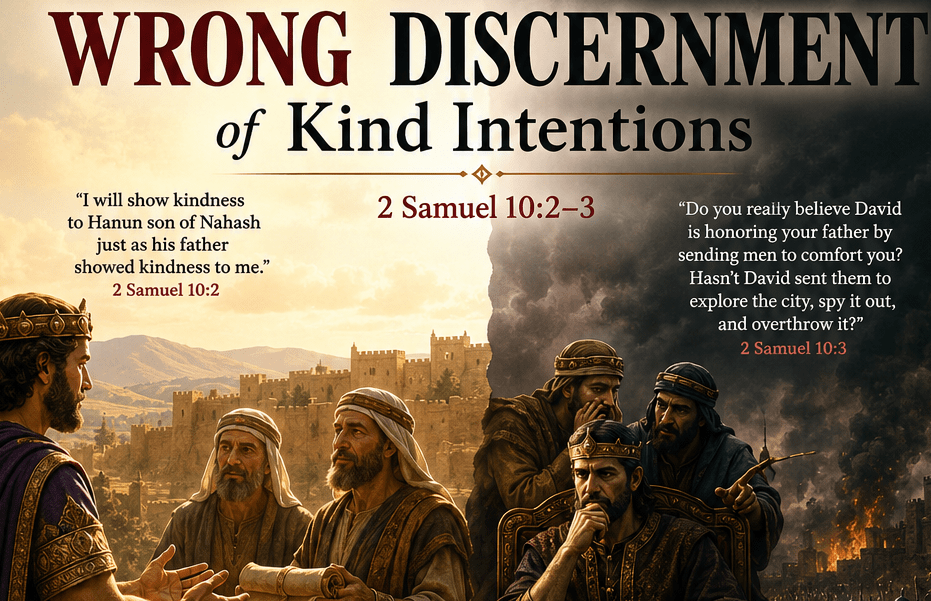
Lessons from Hanun’s Misjudgment of David’s Kindness (2 Samuel 10:2–3)
“Then David said, “I will show kindness to Hanun the son of Nahash, as his father showed kindness to me.” So David sent by the hand of his servants to comfort him concerning his father. And David’s servants came into the land of the people of Ammon” (2 Samuel 10:2-3)
Introduction
Discernment is one of the most valuable qualities a believer can possess. It helps us distinguish truth from error, wisdom from deception, and genuine intentions from hidden motives. Yet discernment is often misunderstood. Many people confuse discernment with suspicion, caution with fear, and wisdom with cynicism.
The account of David and Hanun in 2 Samuel 10 provides a powerful example of how wrong discernment can transform an opportunity for blessing into a season of unnecessary conflict and loss.
Hanun’s story reminds us that not every threat is real, not every act of kindness carries a hidden agenda, and not every voice offering counsel is speaking truth.
The Biblical Context
After the death of Nahash, king of the Ammonites, David sought to honor the kindness Nahash had previously shown him.
David’s intentions were noble and compassionate.
He sent representatives to comfort Hanun and express sympathy during his time of grief.
However, Hanun’s advisors immediately questioned David’s motives.
“Do you really believe David is honoring your father by sending men to comfort you? Hasn’t David sent them to explore the city, spy it out, and overthrow it?” (2 Samuel 10:3)
Without seeking evidence or verifying the accusation, Hanun accepted their interpretation.
He humiliated David’s servants, publicly shamed them, and ultimately provoked a war that brought devastation upon his nation.
One wrong judgment led to widespread consequences.
Lessons on Wrong Discernment
1. Suspicion Can Misinterpret Genuine Kindness
Hanun’s advisors viewed David’s compassion through the lens of fear and distrust.
Instead of seeing comfort, they saw conspiracy.
Instead of recognizing kindness, they imagined manipulation.
This remains a common challenge today.
People who have been wounded, betrayed, or disappointed can begin to interpret every act of kindness with suspicion.
They question motives before receiving love.
They expect deception before considering sincerity.
Yet discernment is not the automatic assumption that everyone has bad intentions.
True discernment seeks truth.
“The inexperienced one believes anything, but the sensible one watches his steps.” Proverbs 14:15
Biblical wisdom neither believes everything nor doubts everything. It seeks understanding.
Personal Reflection
Have I become so guarded by past disappointments that I struggle to receive genuine kindness?
Have previous wounds caused me to question the motives of those who sincerely care for me?
Sometimes pain from the past becomes a lens through which we interpret the present. We begin to expect betrayal even when God sends blessing.
A suspicious heart often misses the people God has assigned to strengthen, comfort, and support us.
Reflection Questions
- Do I assume hidden motives before considering sincere intentions?
- Have I rejected someone’s help because I doubted their sincerity?
- Am I allowing past hurt to influence present relationships?
Prayer
Lord, heal every wound that causes me to view others through suspicion. Give me wisdom without cynicism and discernment without distrust.
2. Wrong Counsel Produces Wrong Decisions
One of Hanun’s greatest mistakes was listening to the wrong voices.
His advisors presented an interpretation, not a fact.
Yet Hanun accepted their conclusions without examination.
The quality of our decisions is often connected to the quality of the counsel we receive.
Many failures begin not with bad intentions but with bad advice.
A leader must carefully evaluate the voices speaking into his or her life.
“Without guidance, a people will fall, but with many counselors there is deliverance.” Proverbs 11:14
Not all counselors are wise counselors. Not all opinions deserve equal weight.
Godly discernment evaluates both the message and the messenger.
Personal Reflection
The voices we listen to shape the decisions we make.
Not everyone who advises us carries wisdom. Some counsel is rooted in fear, jealousy, insecurity, personal experiences, or human reasoning rather than truth.
I must regularly ask whether the voices influencing me are leading me closer to God’s perspective or further away from it.
Reflection Questions
- Who has influence over my decisions?
- Do I seek godly counsel before making important choices?
- Have I ever followed advice without testing it against God’s Word?
Prayer
Father, surround me with wise counselors who fear You. Protect me from voices that distort truth and mislead my judgment.
3. Fear Distorts Perception
Fear has a way of altering reality. When fear governs the heart, people begin to see threats where none exist.
Hanun’s advisors assumed David was pursuing military advantage.
Fear convinced them that compassion was actually espionage.
The same thing happens today.
Fear causes individuals to reject opportunities, mistrust relationships, and misinterpret blessings.
Fear often disguises itself as wisdom. But fear and wisdom are not the same.
“For God has not given us a spirit of fear, but one of power, love, and sound judgment.” 2 Timothy 1:7
Sound judgment is impossible when fear controls our thinking.
Godly discernment flows from faith, truth, and the guidance of the Holy Spirit.
Personal Reflection
Fear can make blessings look dangerous and opportunities appear threatening.
What if Hanun had paused long enough to separate his fears from the facts?
Many times we lose opportunities because fear convinces us that God’s provision is actually a problem.
Fear has the power to magnify danger and minimize truth.
Reflection Questions
- Are there relationships I have avoided because of fear?
- Have I rejected opportunities because I feared being disappointed?
- Is fear influencing my decisions more than faith?
Prayer
Lord, expose every fear that clouds my judgment. Help me see situations through Your truth rather than through anxiety or insecurity.
4. Misjudging People Creates Unnecessary Conflict
David came as a friend. Hanun treated him as an enemy.
The result was a conflict that never needed to happen.
Many broken relationships begin the same way.
Assumptions replace communication. Conclusions are drawn before facts are gathered. People react before understanding.
The damage that follows often takes years to repair.
“Everyone must be quick to hear, slow to speak, and slow to anger.”James 1:19
Godly discernment listens carefully before reaching conclusions. It seeks understanding before reacting.
Personal Reflection
Many conflicts begin not with facts but with assumptions.
A misunderstood conversation. A misinterpreted action. An unverified report.
Before long, relationships become strained because conclusions were formed without understanding.
Reflection Questions
- Have I formed opinions about someone without knowing the full story?
- Have I reacted before seeking understanding?
- Is there a relationship that needs restoration because of misunderstanding?
Prayer
Father, teach me to be quick to hear, slow to speak, and slow to anger. Help me seek understanding before forming conclusions.
5. True Discernment Seeks Evidence Before Judgment
Hanun accepted accusations without investigation.
He never verified the claims. He never questioned the evidence. He simply reacted.
Biblical discernment is different: It does not rush to judgment. It tests, examines, and evaluates. It seeks God’s perspective before forming conclusions.
“But test all things. Hold on to what is good.” 1 Thessalonians 5:21
The believer is called to be thoughtful, prayerful, and careful in judgment.
Truth should always be established before action is taken.
Personal Reflection
Godly discernment is patient: It refuse to rush toward conclusions. It seeks facts, weighs evidence, and invites God’s perspective.
Many wrong decisions could be avoided if we simply paused long enough to verify what we have heard.
Reflection Questions
- Do I verify information before believing it?
- Am I easily influenced by reports and opinions?
- Do I seek God’s perspective before making judgments?
Prayer
Lord, make me a person who values truth. Help me test every report and judge according to righteousness rather than assumptions.
6. Wrong Discernment Can Cause Irreversible Damage
The consequences of Hanun’s decision were severe.
Relationships were damaged. Trust was destroyed. War erupted. Lives were lost.
What began as a misunderstanding became a national crisis.
Wrong discernment often carries a higher cost than people realize.
It can destroy:
- Relationships
- Partnerships
- Opportunities
- Ministry connections
- Friendships
- Divine assignments
Sometimes God sends people into our lives as answers to prayer, but suspicion causes us to reject them.
A blessing can be lost when it is wrongly interpreted.
Personal Reflection
One poor judgment can affect relationships, ministries, businesses, families, and destinies.
Hanun likely never imagined that a decision made in a moment would eventually lead to war.
Our choices often have consequences beyond what we can immediately see.
This reality should drive us toward prayerful dependence upon God.
Reflection Questions
- Have I experienced the consequences of acting without proper discernment?
- What relationships or opportunities have I lost because of wrong assumptions?
- How can I become more dependent on God in my decision-making?
Prayer
Father, preserve me from costly mistakes. Grant me wisdom to recognize Your hand and humility to seek Your guidance before acting.
Marks of Wrong Discernment
Wrong discernment often reveals itself through:
- Judging motives without evidence
- Listening to fear more than truth
- Assuming the worst about others
- Acting before verifying facts
- Allowing past experiences to distort present realities
- Trusting human wisdom above God’s wisdom
These patterns create confusion, division, and unnecessary conflict.
Marks of Godly Discernment
Godly discernment reflects the character and wisdom of God.
It is marked by:
- Seeking truth before reacting
- Testing every report carefully
- Being led by the Holy Spirit
- Distinguishing between fear and wisdom
- Looking for evidence rather than assumptions
- Judging righteously and fairly
Jesus instructed His followers:
“Stop judging according to outward appearances; rather judge according to righteous judgment.”John 7:24
Godly discernment sees beyond appearances and seeks the truth that God reveals.
Leadership Insight
Leaders who fail to discern intentions correctly often:
- Reject genuine helpers
- Welcome wrong influences
- Create unnecessary battles
- Lose strategic relationships
- Lead others into avoidable crises
Hanun lost a potential alliance with David because he interpreted kindness through suspicion rather than wisdom.
Leadership requires more than intelligence.
It requires spiritual discernment.
A leader must learn to distinguish between legitimate caution and destructive suspicion.
Final Heart Reflection
Before criticizing Hanun, we must ask ourselves:
- Have I ever doubted someone God sent to help me?
- Have I ever allowed fear to influence my interpretation of a situation?
- Have I accepted a report without verification?
- Have I misjudged someone’s intentions?
- Have I allowed past experiences to distort present realities?
Wrong discernment is not merely a leadership issue—it is a heart issue.
The heart that walks closely with God becomes increasingly capable of seeing people, circumstances, and opportunities through His eyes.
Prayer Points
- Father, deliver me from suspicion and ungodly assumptions.
- Grant me discernment that comes from Your Spirit and not from fear.
- Help me recognize genuine relationships and divine connections.
- Protect me from counselors who distort truth.
- Teach me to seek evidence and wisdom before making judgments.
- Let me not reject the people You have sent to help me.
- Give me a heart that discerns according to Your truth and not appearances.
“9 And this I pray, that your love may abound still more and more in knowledge and all discernment, 10 that you may approve the things that are excellent, that you may be sincere and without offense till the day of Christ,”Philippians 1:9–10
Closing Prayer
Father, I ask You to develop in me true spiritual discernment. Deliver me from suspicion, fear, assumptions, and premature judgments. Teach me to seek truth before reacting, wisdom before deciding, and Your perspective before concluding. Help me recognize the people, opportunities, and blessings You send into my life. May my discernment be governed by Your Spirit and rooted in Your Word. In Jesus’ name, Amen.
Conclusion
The tragedy of Hanun was not that David came with bad intentions. The tragedy was that genuine kindness was misinterpreted.
Wrong discernment can transform friends into enemies, blessings into threats, and opportunities into losses.
As believers, we must resist the temptation to judge prematurely. We must seek truth before reacting, wisdom before deciding, and God’s perspective before concluding.
May God grant us hearts that discern accurately, judge righteously, and recognize the blessings He sends our way. May we be people who are led not by suspicion, fear, or appearances, but by the wisdom of the Holy Spirit and the truth of God’s Word. Amen.

